Monday News Roundup

Here's what you missed from our Twitter Feed last week!

What would cities say to one another if they could talk? (Sustainable Cities)
Featuring "Metropopular," a charming animated short film exploring city stereotypes through an imagined dialogue between anthropomorphized metropolises.

Popsicles and the Importance of Simplicity (PlaceShakers and NewsMakers)
Rehashing the importance of simplicity via the “popsicle test” — the ability of an 8 year old to safely get somewhere to buy a popsicle, then make it home before it melts — as the measure of a good neighborhood.

One Path to Better Jobs: More Density in Cities? (Planetizen)
Economist Ryan Avent writes that the statistics show that people who live in denser cities have better jobs and are more productive.

More "Parklets" Pop Up in Vancouver (Planetizen)
Transplanting the wildly popular pilot projects in NYC and SF across the northern border, the City launches VIVA Vancouver program that converts parts of eight streets into public spaces.

Ever seen roofing made from the wings of a 747? (Design Milk)
The 4,000-square-foot Wing House, as it has become known, is made from an old plane that was 230 feet long, 195 feet wide and 63 feet tall, but cost David barely nothing.

Polluting power plants turned green neighborhood development? (Switchboard)
Industry analysts predict that environmental and economic factors will lead to the retirement of dozens of aging coal-fired power plants in the coming decade, which present tremendous opportunities for new civic and private uses.

100% Design London (Life of an Architect)
Some of what you will be missing at this year's 100% Design London festival - a showcase of a vast range of weird and wonderful materials from wood and plastic to embroidered wallpaper and steel cladding.

Meaningful Sanctuary in a Space for Many

By Kristin Jensen, Interior Designer
VIA Architecture

I can say that I enjoy living in an apartment built in 1898, because I am a person who appreciates the design details of the time.  For me, built-ins, high ceilings, solid wood mouldings, large bright windows, and hardwood floors are more important interior details than new appliances, modern heating, or a dishwasher (Okay, I kick myself sometimes for living without a dishwasher.)  There is something so satisfying about coming home to solid interior elements.  They create a sanctuary.
The Grex, 1898
The once common telephone nook
When I say “sanctuary”, I don’t mean a refuge or shelter, “sanctuary” here is like the inmost recess, the holiest part of the church that contains the altar.  I once lived in an apartment where I could hear the woman above me sneeze.  I did very little living that year and a lot of worrying about being quiet to avoid eviction for breathing too loud.   That apartment was a shelter from the outdoors, but it was not a sanctuary.
 More than a roof over a head, a sanctuary makes us feel comfortable, secure, and peaceful.  In a sanctuary, we can be dynamic and joyful.  We can create calm.  We can project ourselves into the space and feel reassured in return by the interior’s design. 
 Simple design elements are part of making a sanctuary, such as wall color; light grey for "calm", a vibrant yellow for "lively."  The feeling and choice is as unique as the individual.   As an interior designer, I have the vocabulary to help individuals realize their vision.  But, what happens when designers are speaking for large groups?  The needs of the whole overshadow personal preferences.  In large project architecture firms, this is the interior designers’ challenge.  
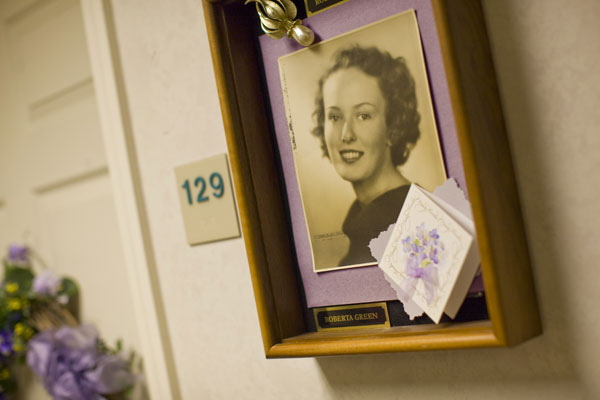
I am currently working on an Assisted Living project, where EVERYTHING has more purpose and meaning than the average individual eye can see.   For the residents that will live there, it is the type of place that many would understandably be reluctant to call home.  Whereas a personal sanctuary reflects individual choices and independence, most assisted living residents will move in with neither.  Yet, it is the space that will last longer than their memories and will likely be the last interior space image they remember.
The design elements of assisted living are driven by operational and elder care needs.  Wall color that is soothing, lighting for older eyes, stain resistant carpet - those are easy.  But, choosing carpet that doesn't disturb depth perception, chair rails that are really hand rails, wall coverings that indicate floor levels, and room dividers that act as walker storage are the things that an individual doesn’t notice, let alone think about.
Every design element has a reason, everything has a purpose, every detail is meaningful.  Designing a space to function well is integral to the purpose of the building as a whole. Allowing the space to address individual emotional needs are also essential to creating a sanctuary for a large number of residents.  We can create interior spaces that are harmonious to surrounding communities and residences to bring inside some of the much needed outside.  For example, many residents will find a lonely bench in a long corridor as a much needed friend.  A prominent place in each room to display a treasured piece of themselves will let residents show everyone who they are. 
Memory Box
 Once the common areas are defined and designed, it comes back to the details.  It is in the details that a space becomes  an inviting place and a room becomes a sanctuary.  The challenge is knowing that it is ultimately the individual who decides what is meaningful to them and what is simply “taking up space.”  Wrestling with these details is all an investment in sanctuary.  I think about it all the time.  I think of details that convey the feelings we get from a piece of art or from something as simple as a smile.   I think, back in my apartment, part of my sanctuary is reflected in the sponge that matches the dish towels and pot holders.  Through interior details, large and small, we seek to give the residents on our project the sanctuary they deserve.